India now has the rulebook and the sign-up portal for DPDP consent managers, the apps that are supposed to let you give, check and pull back permission to use your personal data from one place instead of hunting through dozens of privacy pages. The registration framework under the Digital Personal Data Protection (DPDP) Act took effect on 13 November, and MeitY announced the application portal at dpbi.gov.in on 14 November. As of 16 November, the Board had not published a list of approved services for readers to use. The wider rules on company notices, consent and your rights start on 13 May 2027.
What is a DPDP consent manager?
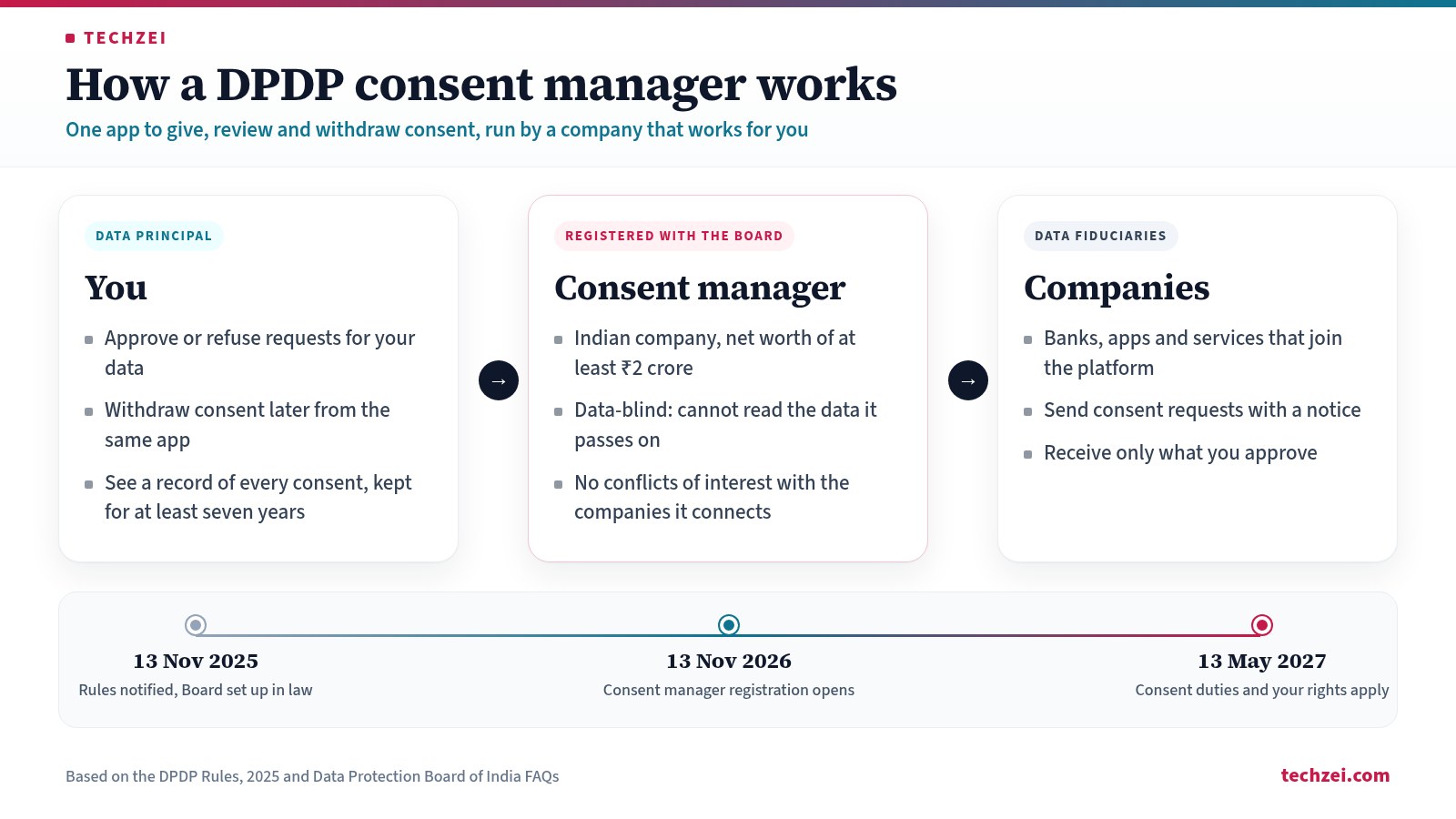
Under the DPDP Act, a consent manager is a company registered with the Data Protection Board of India that gives you one accessible, interoperable platform to give, manage, review and withdraw consent. The important part is whose side it is on. The Rules say a consent manager must act in a fiduciary capacity towards you, the Data Principal, and the Board’s FAQ says it is accountable to you, not to the companies asking for your data.
The Rules give a simple example: a bank asks for your bank statement on the platform, and you approve it and share the statement from your digital locker, or tell your existing bank to send it. If you have used an account aggregator for a loan, this will feel familiar, but a DPDP consent manager can cover any company (a Data Fiduciary) that joins its platform, not just financial firms.
What consent managers have to do
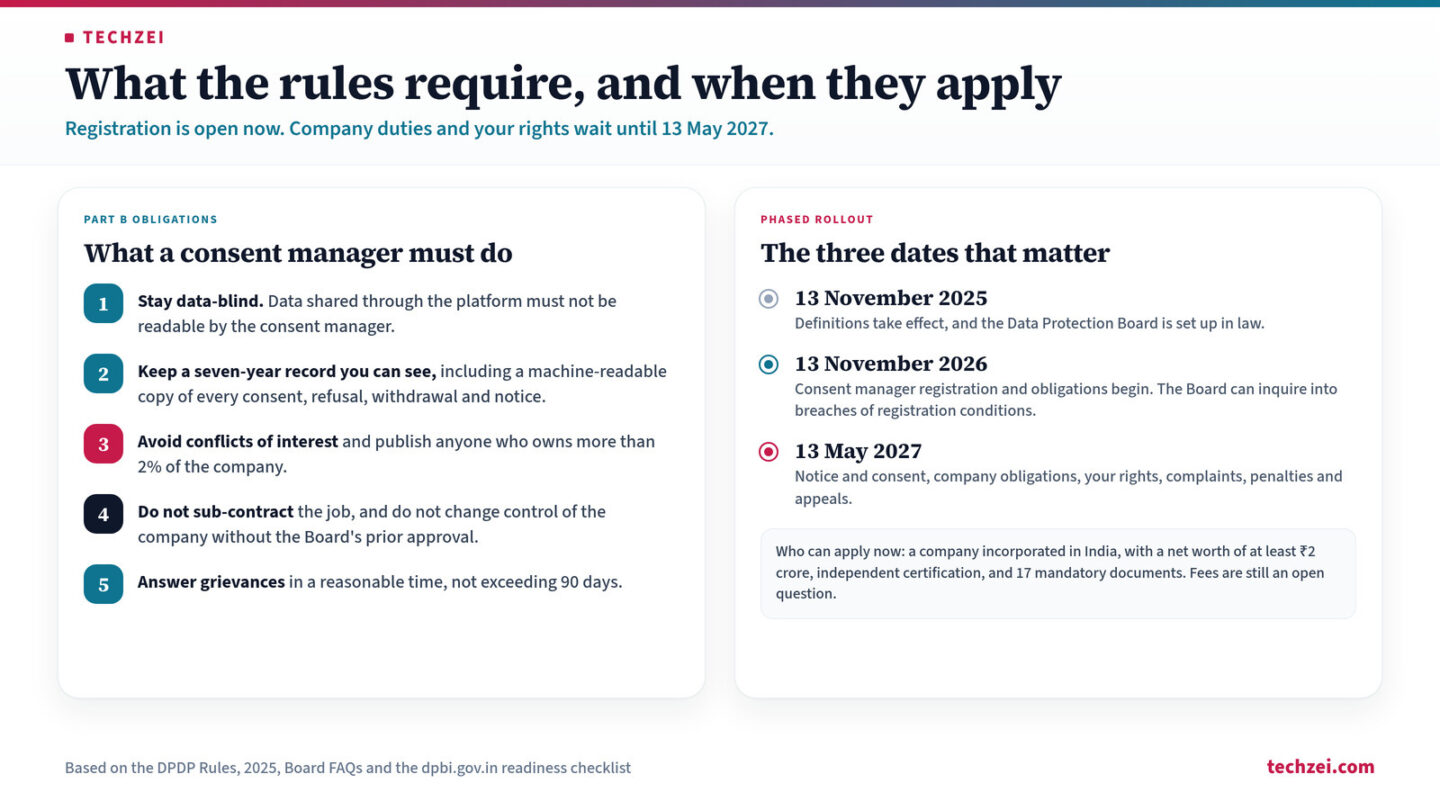
The obligations in Part B of the First Schedule of the DPDP Rules, 2025 are specific:
- Data-blind by design. Data shared through the platform must not be readable by the consent manager. It passes your data along without looking at it.
- A seven-year record you can see. It must log every consent you give, deny or withdraw, the notice behind each request, and any sharing of your data. You can access the record, get a machine-readable copy, and it must be kept for at least seven years.
- No conflicts of interest. It must avoid conflicts with the companies on its platform, including through promoters, directors and senior management, and publish who owns more than 2% of it.
- No outsourcing and no quiet sale. It cannot sub-contract its obligations, and control of the company cannot change hands through a sale or merger without the Board’s prior approval.
- A grievance desk. It must publish a grievance redressal system on its app or website and respond within a reasonable time, not exceeding 90 days.
Who can become a consent manager
Only a company incorporated in India with a net worth of at least ₹2 crore can apply, and its platform must be independently certified against data protection standards the Board will publish. The portal lists 17 mandatory documents, including a system architecture document explaining the data-blind design, a conflict-of-interest policy, a business continuity plan and a business plan covering the "operating model and fees". Applicants log in with their Corporate Identification Number, and the Board either rejects an application with reasons or registers the company, gives it a Registration ID and adds it to the public list.
That "fees" line matters to you. Neither the Rules nor the Board’s FAQ say a consent manager has to be free for users, and applicants have to describe their own fee model. Whether you pay, the companies pay, or both, is still an open question.
Registration is open, but the wider rights arrive in 2027
The Board has opened applications, but its site did not show a public list of approved consent managers on 16 November. That means we cannot point you to a registered service yet. The government says the Board will publish approved names on its website.
The DPDP Act is taking effect in three phases:
| Date | What applies |
|---|---|
| 13 November 2025 | Definitions and the legal setup of the Data Protection Board |
| 13 November 2026 | Consent manager registration and obligations, and the Board’s power to inquire into breaches of registration conditions |
| 13 May 2027 | Notice and consent, company obligations, your rights, complaints to the Board, penalties and appeals |
Until May 2027, the duties on companies to give proper notices and honour withdrawals under the DPDP Act are not in force, so even the first registered consent manager will have limited legal weight behind it at the start.
What you should do now
There is nothing to install yet. Check the Board’s official website for approved consent managers before trusting an app that claims to be registered. Its site currently offers an application route for companies, not a public list of services for users.
Once a registered manager is operating, raise a grievance with it first. The Board’s FAQ says you must give the manager a chance to resolve the issue before complaining to the Board.
From 13 May 2027, the DPDP Act’s wider rights begin, including access to information about the personal data a company holds, correction and erasure, and withdrawal of consent. Those rights apply through the wider legal framework, whether or not you use a consent manager.
My take
The rules get the hard parts right: a data-blind design, strict conflict-of-interest limits and a downloadable seven-year consent log. But a consent manager is only as useful as the companies connected to it. If your bank, telecom operator, shopping apps and health services do not join, you will still be managing consent one app at a time. The rules so far describe what consent managers must do, not which companies have to plug into them.
The first approvals, and their fee models, will show whether this becomes a real tool for Indian users or a compliance box.